
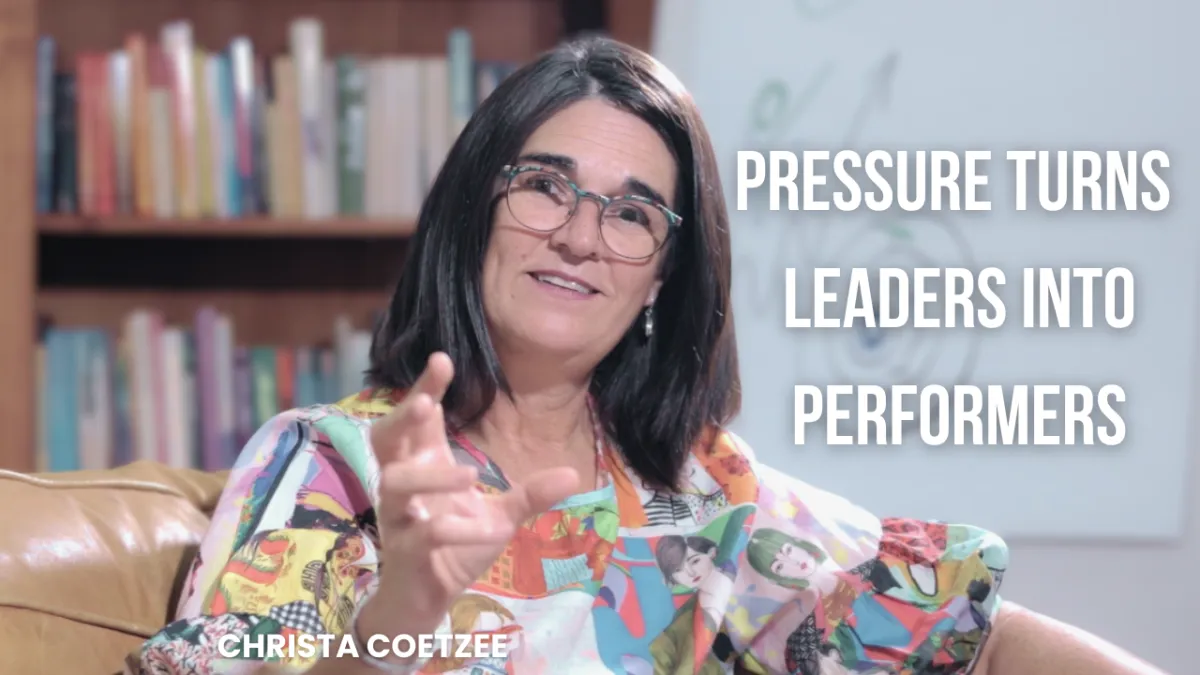
Pressure Turns Leaders Into Performers
There is a quiet moment that leaders recognise, even if they have never named it.
It happens just before you walk into a meeting where the stakes feel high. Before you speak in front of your team. Before you respond to an email you know will be read closely. Something shifts internally. Your body tightens. Your thoughts speed up. You become acutely aware of how you are about to show up.
You want to get it right.
And in that moment, without consciously deciding to, you move from presence into performance.
This shift is so common in leadership that it often goes unquestioned. We assume it is professionalism. We tell ourselves it is competence. But over time, it creates a subtle and costly disconnect not only from others, but from ourselves.
This is not a failure of character. It is a nervous system response. And understanding this distinction changes how we lead.
Why Pressure So Easily Pulls Us Away From Ourselves
Pressure does not arrive loudly. It often disguises itself as responsibility.
Targets need to be met. People are watching. Decisions matter. Outcomes have consequences. These are not imagined pressures; they are real. But the body does not experience them intellectually. It experiences them physiologically.
When the nervous system detects risk and social judgment is a form of risk, it prepares us to protect ourselves. For some, this looks like control. For others, perfectionism. For many leaders, it looks like performance.
Performance is not about ego. It is about safety.
When we perform, we monitor ourselves closely. We choose words carefully. We manage impressions. We focus on how we are being perceived rather than what is actually happening in the room. The intention is usually good to lead well, to be effective, to not let others down but the impact can be the opposite. Presence is replaced with precision. Connection is replaced with control and people feel it.
How Performance Quietly Breaks Connection at Work
Teams are far more perceptive than we give them credit for. They notice tone changes. They feel emotional shifts. They sense when a leader is available and when they are armoured.
When a leader moves into performance mode, something subtle happens in the room. Conversations become safer but less honest. People share less of what they really think. Creativity narrows. Emotional risk disappears.
This is not because people stop caring. It is because the environment no longer feels relational it feels evaluative. Pressure is contagious. When leaders feel it and perform under it, teams absorb it and respond in kind. They perform too. They comply. They stay busy. They meet expectations. But connecting the foundation of trust and resilience erodes quietly. Over time, organisations mistake productivity for health, and output for alignment.
Where These Patterns Often Begin
For many of us, performance did not start at work. It started much earlier.
Some grew up in homes where expectations were high, and mistakes were visible. Others learned early that approval came through achievement, compliance, or emotional restraint. Some were placed in roles, family, cultural, or social where being “good,” “strong,” or “capable” was not optional.
These early experiences shape how we respond to visibility and responsibility. When we step into leadership roles later in life, those patterns are reactivated. The body remembers what the mind may not.
So when pressure rises, we default to what once kept us safe. Understanding this is not about blame or self-criticism. It is about awareness. Because without awareness, we confuse authenticity with weakness and performance with leadership.
The Cost of Always Needing to Get It Right
One of the most overlooked leadership risks is the belief that we must always appear composed, confident, and certain. This belief creates internal tension. Leaders begin editing themselves in real time. They suppress uncertainty. They disconnect from their own internal signals. Over time, this leads to exhaustion not because leadership is hard, but because self-monitoring is relentless.
More importantly, it deprives teams of something essential: a human leader. People do not need leaders who never falter. They need leaders who are grounded enough to stay present when things are unclear, uncomfortable, or complex. Presence communicates safety. Performance communicates pressure.
Learning to Stay Real When the Stakes Are High
The work of staying real under pressure does not start with better communication techniques. It starts with the body. When pressure hits, the most effective first response is not to speak, it is to pause. To breathe. To notice what is happening internally before reacting externally.
This pause interrupts the automatic nervous system response. It creates space for choice.
From that space, a different question becomes available:
What actually needs to be communicated right now?
Not what will sound impressive.
Not what will protect my image.
But what is true, aligned, and useful.
Leaders who lead from this place communicate more clearly, not less. Their words land because they are grounded in intention rather than fear.
Authority Without Performance
There is a misconception that authenticity undermines authority. In reality, the opposite is true. Authority does not come from flawless delivery. It comes from coherence when what a leader says aligns with how they show up and how they make others feel.
Authentic leadership is not about oversharing or emotional exposure. It is about congruence. Being steady enough to hold responsibility without hiding behind performance. When leaders cut through self-imposed expectations, the need to be perfect, to never hesitate, to always know, they model something powerful: permission to be human with accountability.
This is where trust grows.
Why This Matters More Than Ever
We are leading in a time of chronic pressure. Constant change. Uncertainty. Information overload. People are tired, stretched, and increasingly disconnected from meaning.
In these conditions, leadership presence is not a “soft skill.” It is a stabilising force. Teams do not need louder direction. They need leaders who can regulate themselves under pressure and create environments where others can do the same. This is not about lowering standards. It is about raising awareness.
Pressure will not disappear. Expectations will remain. Leadership will always involve risk. But performance does not have to be the default response. We can learn to recognise when we are slipping into it. We can pause. We can breathe. We can return to intention. And we can choose presence again and again.
Not because it is easy, but because it is effective. And because leadership, at its best, is not about being impressive. It is about being real enough to lead people through what actually matters.
Click HERE for the Pressure Turns Leaders Into Performers video on my You Tube Channel